
Emergency Lighting & Exit Lights: Requirements for Commercial Buildings in India
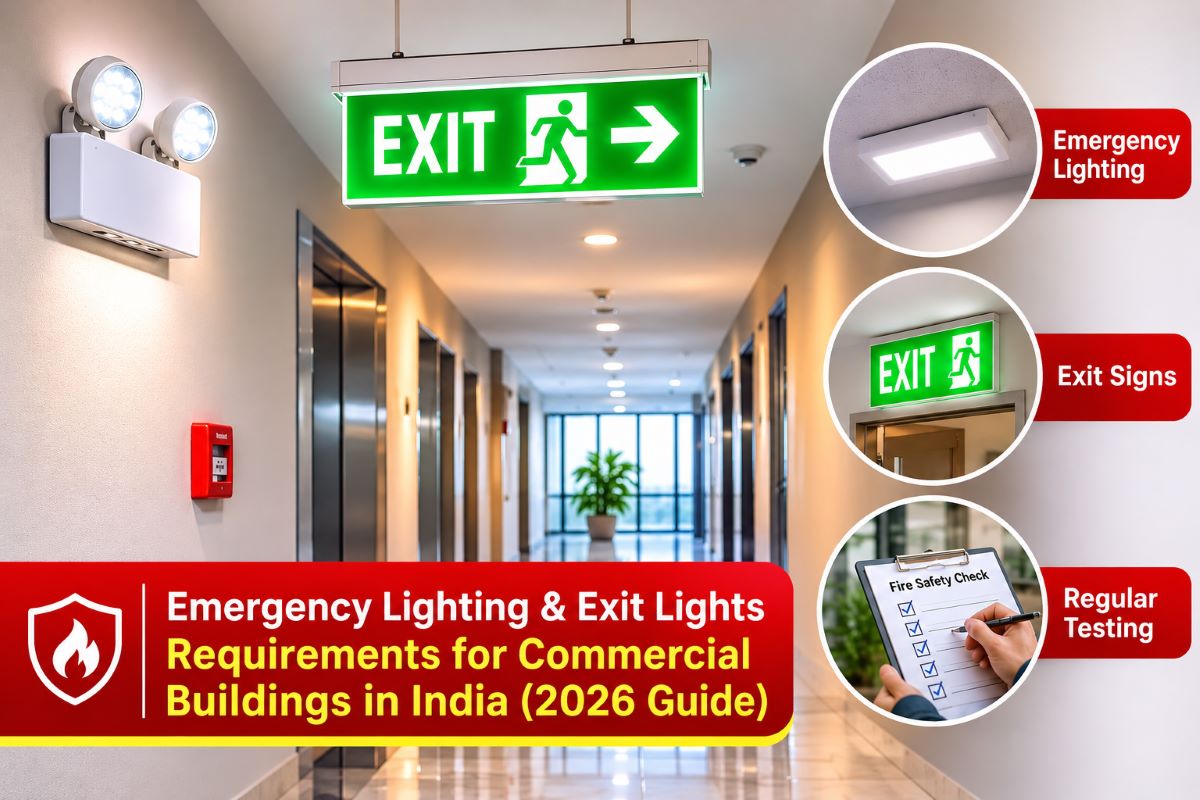
When the power fails during a fire, a stairwell goes dark in seconds. Emergency lighting and illuminated exit signs are what let people find the way out. They are also among the first things a fire officer checks during a Fire NOC inspection.
This guide explains what Indian commercial buildings need, where the lights go, how long they must run, and what typically fails an inspection.
Quick Answer: What Are the Requirements?
Commercial buildings in India need battery-backed emergency lights along escape routes and illuminated exit signs at every exit. These systems should switch on automatically when mains power fails and stay lit for at least 90 minutes. The requirements come from the National Building Code (NBC) 2016 Part 4, now succeeded by NBCS 2026, along with BIS standards and the local fire department’s Fire NOC conditions.
Emergency Lighting vs Exit Signs: What’s the Difference?
People often treat these as one item, but they do different jobs.
- Emergency lighting illuminates corridors, stairs, lobbies, ramps and exit paths so people can walk out safely when normal lighting fails.
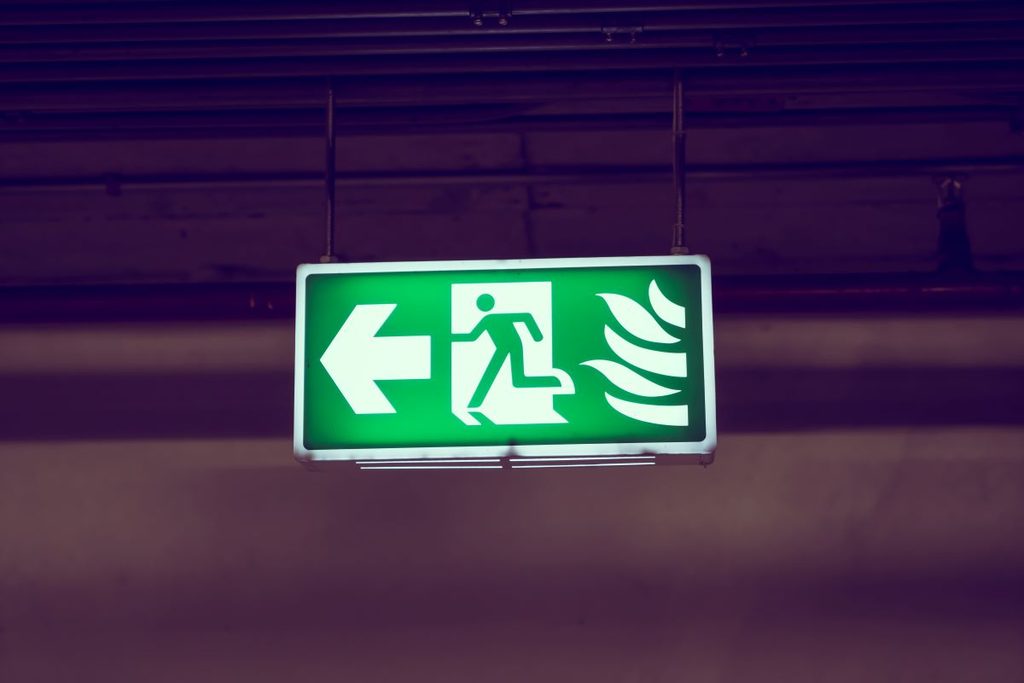
- Exit signs mark the exits and the route to them. They must be visible from any point along the escape path, using arrows and pictograms.
A building needs both. A bright sign above a dark staircase is not a safe exit.
The Regulatory Framework
Four layers apply to most commercial projects:
- NBC 2016 Part 4 (Fire and Life Safety), which covers means of escape and egress lighting. NBC 2016 has now been replaced by the National Building Construction Standards 2026 (NBCS 2026). Check the current edition with your fire consultant.
- BIS standards on exits and fire safety of buildings, such as IS 1644 and IS 1646.
- State fire service rules, which govern the Fire NOC and its renewal.
- Insurer requirements, which often add inspection conditions beyond the code.
Enforcement differs by state, but the Fire NOC is where it matters in practice. Without a valid NOC, a building can face problems with occupancy approval, insurance claims and renewals.
Core Technical Requirements
Figures vary slightly between references and occupancy types, so treat this table as a planning guide and confirm the final values with your fire consultant and local fire authority.
| Parameter | Typical requirement |
| Activation | Automatic on mains failure (within seconds) |
| Battery duration | Minimum 90 minutes; longer for hospitals, hotels and assembly spaces |
| Escape-route illumination | Roughly 1 lux average along the path |
| Exit sign visibility | Visible from any point on the route, with directional arrows |
| Power source | Battery, central battery system, inverter or generator-backed |
| Circuit | Dedicated emergency circuit, independent of normal lighting |
| Testing | Built-in self-test or documented manual testing |
Where Emergency Lights and Exit Signs Are Required
Install them wherever people must travel to leave the building safely:
- Exit doors and final exits to open air
- Staircases, landings and fire-escape stairs
- Corridors, lobbies and open-plan floors
- Basements and parking levels
- Fire pump rooms, control rooms and electrical rooms
- Lift lobbies and refuge areas
- Server rooms, data centres and plant rooms
Basements and windowless spaces need particular care. They have no daylight, so a power cut leaves them completely dark.
Data centres are also under closer scrutiny now. A new circular takes effect on November 6, with stricter fire safety rules for data centres, including a provisional Fire NOC process and limits on basement use. Operators should review their egress lighting as part of that exercise.
Types of Emergency Lighting Systems
Maintained fittings stay on all the time and are common for exit signs. Non-maintained fittings switch on only when power fails and suit corridors and stairs.
For the power source, you have two main options:
- Self-contained units have a battery in each fitting. They are simple to install and suit smaller offices, retail spaces and retrofits.
- Central battery systems feed many fittings from one battery bank. They suit hotels, malls, hospitals, IT parks and high-rise towers, where monitoring and maintenance are easier from one place.
LED fittings have become the standard choice. They draw less power, last longer and extend battery life.
Common Mistakes That Fail Inspections
- Dead or degraded batteries. Lights that glow for ten minutes instead of ninety fail the duration requirement.
- Exit signs blocked by decor, hanging banners or partitions added after the original design.
- Wrong placement. Signs that don’t guide people at every turn or junction.
- No testing records. Inspectors ask for logs, not verbal assurances.
- Sharing circuits with normal lighting, so a single fault disables both.
- Mixing old and new fittings with mismatched ratings.
- Ignoring tenant fit-outs. Interior changes often break the original escape-route lighting layout.
Testing and Maintenance Best Practice
Dependable emergency lighting comes from routine checks:
- Monthly: short functional test, confirming every fitting lights up and indicators show normal.
- Annually: full-duration test to confirm the 90-minute battery run.
- Ongoing: replace batteries on schedule, clean lenses and keep exit signs unobstructed.
- Always: keep dated test records for audits and Fire NOC renewal.
Most building owners find this easier through a fire safety Annual Maintenance Contract (AMC) than by relying on in-house staff. Learn how that works with Elixir Engineering’s fire safety services.
How to Check Your Building
Walk each escape route as if the power had just failed. Ask yourself:
- Can I see the exit sign from every point on the path?
- Is every stair landing lit?
- Do the lights come on automatically when mains is switched off?
- Do they last the full 90 minutes?
- Do I have written test records for the last 12 months?
If any answer is “no” or “not sure,” arrange a professional fire audit before your next Fire NOC inspection.
Frequently Asked Questions
Yes, in most commercial occupancies. NBC-based fire and life-safety provisions require emergency lighting along escape routes, and Fire NOC inspectors check for it. Very small premises may have different thresholds, so confirm with your local fire department.
At least 90 minutes after a power failure is the commonly cited minimum for commercial buildings. Hospitals, hotels and assembly spaces often need a longer duration.
Yes. Exit signs should be clearly visible and illuminated, with backup power so they stay lit during an outage.
Maintained lights are on at all times and switch to battery during a failure. Non-maintained lights switch on only when mains power fails.
A short monthly functional test and a full-duration annual test are widely followed practice. Keep written records of both.
Yes. They should be on a dedicated emergency circuit so a fault in normal lighting does not disable them.
They do. Emergency lighting and exit signage are part of the fire-safety compliance an inspector verifies, both at issue and at renewal.
Yes. Self-contained LED units make retrofits practical in most offices and retail spaces, and central battery systems suit larger buildings.