
Fire Hose Reel: Components, Installation Rules & Hose Reel vs Hydrant
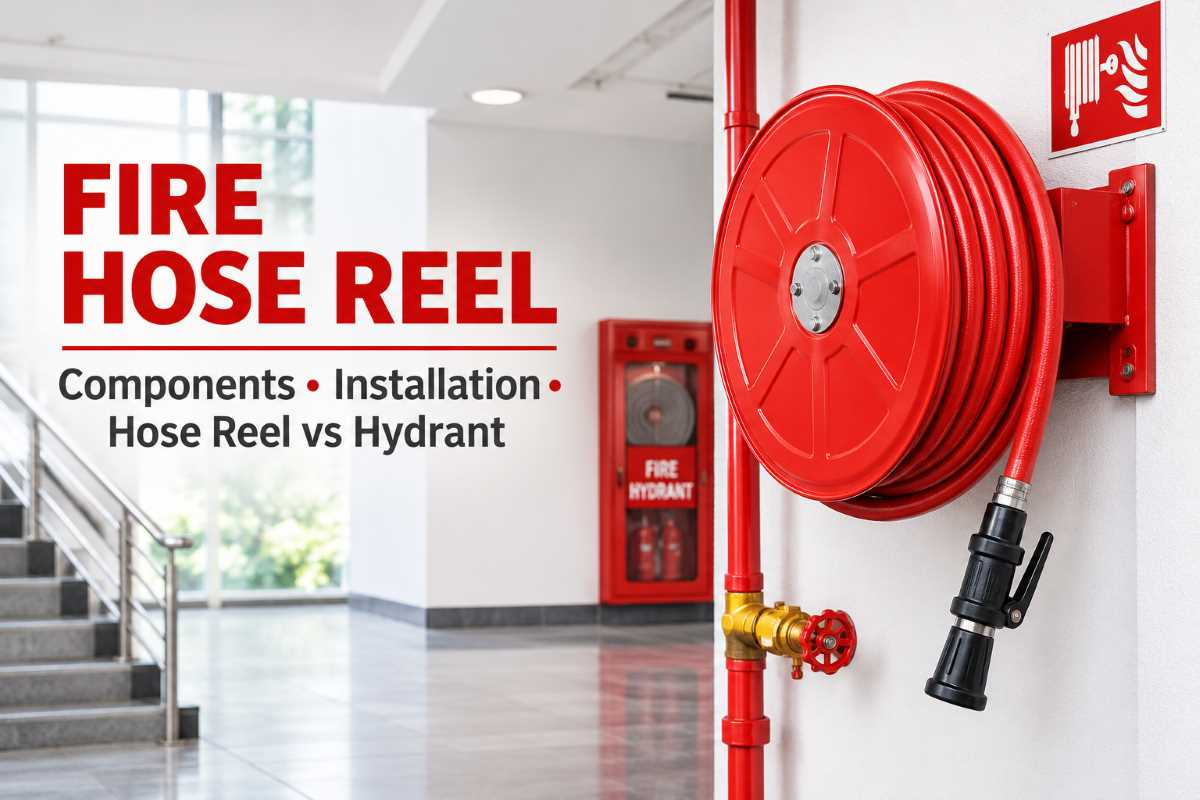
In the first minute of a fire, the person standing closest to it decides how big it gets. A fire hose reel gives that person a charged, ready-to-use water line with no coupling, no priming and no training in firefighting hose handling. It is the “first-aid” tool of a building’s fire protection system.
This guide explains what a hose reel is made of, how it must be installed in Indian buildings, and how it differs from a fire hydrant, so you can specify, inspect and maintain it with confidence.
Quick Answer: What Is a Fire Hose Reel?
A fire hose reel is a wall-mounted drum holding a length of semi-rigid, small-bore hose, permanently connected to a pressurised water supply and fitted with a shut-off nozzle. In India, first-aid hose reels follow IS 884 (the equipment specification, revised in 2025) and are installed and maintained under IS 3844 and the National Building Code (NBC) Part 4. They let occupants tackle a small fire before the fire brigade arrives.
Key Components of a Fire Hose Reel
Every part has a job, and a failure in any of them can leave the reel useless when needed.
| Component | Function |
| Reel drum | Holds the hose and rotates smoothly so it can be pulled out fully without kinking |
| Hose (tubing) | Semi-rigid, non-collapsible rubber or reinforced hose, typically 19 mm bore and up to 36 m long |
| Nozzle | Shut-off type, so water flow is controlled and wastage is avoided |
| Swivel inlet / swinging arm | Lets the reel swing about 180 degrees on its bracket and feeds water into the rotating drum |
| Wall bracket | Carries the weight of the full drum and mounting hardware |
| Isolating (stop) valve | Opens the water supply and allows isolation for maintenance |
| Cabinet or guard (optional) | Protects the reel and carries signage |
IS 884 covers materials, construction and testing for these parts, and ISI-marked reels are the safe choice for compliant installations.
How a Fire Hose Reel Works
The reel is connected directly to the building’s riser or down-comer, so water is available at the moment the valve opens. The user opens the valve, pulls the hose towards the fire and operates the nozzle. Because the hose is semi-rigid, water can flow even when the hose is only partly unreeled, which is a major safety advantage over flat canvas hose.
Installation Rules for Hose Reels in India
Exact requirements depend on building height, occupancy and your state fire rules, so always confirm with your fire consultant. The core rules below are widely followed.
- Direct connection to the riser. The reel should be connected directly to the riser or down-comer main, not through a hydrant outlet that needs setting up first.
- Hose size. Hose bore should not be less than 19 mm, in line with IS 884, with a typical length of 36 m.
- Location. Install reels on every floor, commonly at staircase landings and along exit routes, so that every part of the floor can be reached by the hose and its water jet.
- Provision with hydrants. NBC-based checklists commonly call for one hose reel with every hydrant, including in basements.
- Mounting height. Reels are generally mounted so the valve and drum are comfortable to reach, commonly quoted as 0.8 m to 1.5 m above floor level. Confirm against IS 3844.
- Clear access. Keep the area in front of each reel free of stored goods, partitions and furniture.
- Signage. Mark each reel clearly with fire-safety signage visible from the approach path.
- Pressure and flow. The system must deliver adequate pressure at the highest and furthest reel, which is verified during commissioning.
Buildings are now moving to the new National Building Construction Standards (NBCS 2026), so check the current edition for height thresholds and occupancy tables.
Fire Hose Reel vs Fire Hydrant: What’s the Difference?
The two systems work together, but they are designed for different people and different fire sizes.
| Feature | Hose reel | Fire hydrant (internal) |
| Purpose | First-aid attack on small fires | Heavy firefighting by trained personnel |
| Typical user | Building occupant or security staff | Fire brigade or trained fire team |
| Hose | Semi-rigid, about 19 mm, up to 36 m | Canvas or rubberised hose, about 63 mm, 15 m lengths |
| Water flow | Lower | Much higher |
| Setup | Open valve and go, connected permanently | Needs hose, branch pipe and coupling at a landing valve |
| Operation | One person | Usually two or more |
| Best for | Incipient fires, first 1 to 2 minutes | Established or spreading fires |
Simple rule: use the hose reel to stop a small fire early, and use hydrants when the fire has outgrown first-aid response.
Neither one replaces the other. Most commercial and industrial buildings need both, along with extinguishers, sprinklers where required, alarms and emergency lighting.
Where Hose Reels Are Typically Required
- High-rise residential and commercial towers
- Hotels, hospitals and malls
- Educational buildings
- Industrial plants and warehouses
- Basements and parking levels
The NBC tables link requirement to building height and occupancy class, and many local fire departments add their own conditions to the Fire NOC.
Common Mistakes That Cause Failures
- Blocked access from stored goods or renovation work
- Dry or leaking riser, so the reel has no pressure when opened
- Cracked or perished hose that has never been unreeled in years
- Seized valves or swivels, caused by corrosion
- Missing or damaged nozzles
- No inspection records, which fails audit even if the reel works
Inspection and Maintenance Checklist
Hose reels sit untouched for years, which is exactly why they fail. A simple routine prevents that.
- Monthly: visual check of the reel, bracket, signage and access.
- Quarterly: unreel the hose fully, check for cracks, kinks and leaks, and operate the valve and nozzle.
- Annually: run a flow and pressure test, lubricate moving parts and replace worn components.
- Always: keep dated records for audits and Fire NOC renewal.
A fire safety Annual Maintenance Contract (AMC) is the easiest way to keep this on schedule. Explore Elixir Engineering’s fire-fighting and maintenance services.
Frequently Asked Questions
It is used for first-aid firefighting. Occupants use it to fight small fires before the fire brigade arrives.
A bore of 19 mm is the commonly specified size under IS 884, typically supplied in lengths of up to 36 m.
A hose reel has a small-bore, semi-rigid hose for quick use by one untrained person. A hydrant uses a larger hose with higher flow and is meant for trained fire teams.
In many building types it is, depending on height and occupancy as set out in NBC Part 4 and state fire rules. Your fire consultant or local fire department can confirm the requirement for your building.
IS 884 covers the equipment specification, and IS 3844 covers installation and maintenance.
With a 36 m hose plus the nozzle jet, coverage is commonly designed around 30 m from the reel, but exact layout is set during fire design for each floor.
Check them visually every month, unreel and test them every quarter and do a full flow and pressure test annually.
No. Water is unsuitable for live electrical equipment and flammable-liquid fires. Use the right extinguisher, such as CO2 or dry chemical powder, for those hazards.