
Fire Alarm Control Panel (FACP): Types, Components, How It Works & How to Choose
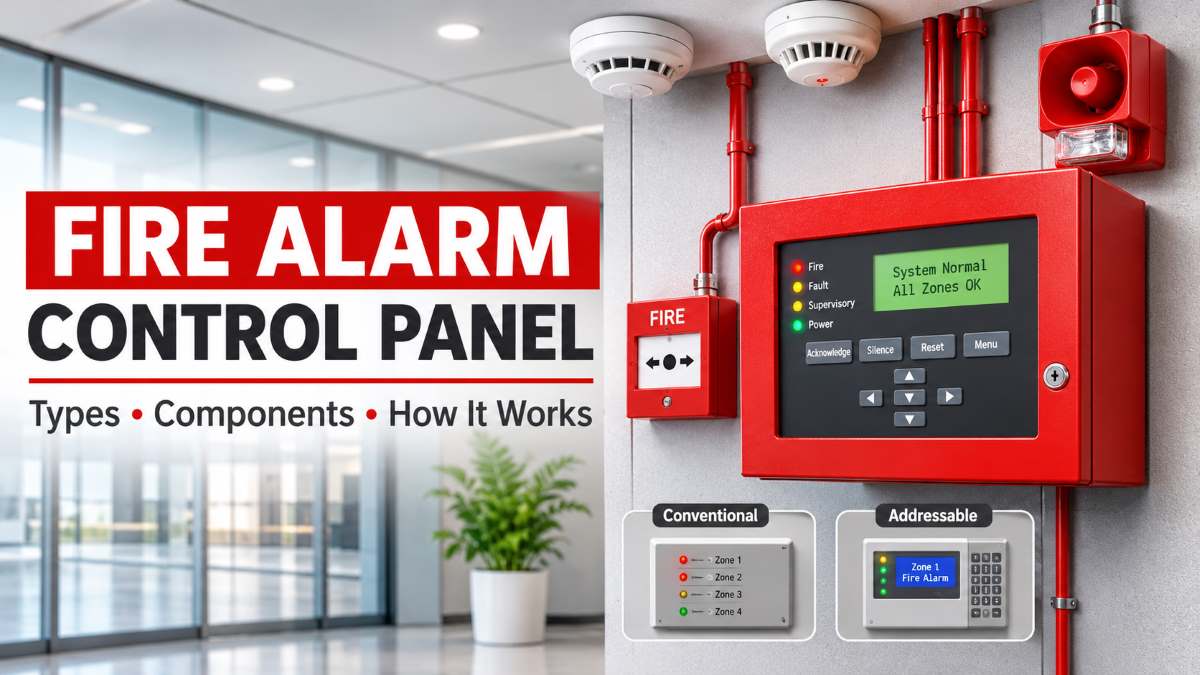
A fire alarm panel is the brain of a building’s fire detection system. Every smoke detector, heat detector, manual call point and sounder reports to it, and it decides what happens next: raise the alarm, show the location, trigger fire doors, shut down air handling or call for help.
Choosing the wrong fire alarm control panel (FACP) is expensive. A panel that is too small cannot grow with the building, and one that is too basic cannot tell you where the fire is. This guide explains the main fire alarm control panel types, the fire alarm system components around them, how the system works, and how to choose the right panel for your premises.
Quick Answer: What Is a Fire Alarm Control Panel?
A fire alarm control panel (FACP) is the central unit that monitors fire detectors and manual call points, signals alarms through sounders and strobes, displays the location of a fault or fire, and operates connected safety functions. In India, installation and maintenance of fire detection and alarm systems follow IS 2189, alongside NBC Part 4 and your local fire department’s Fire NOC conditions.
Fire Alarm System Components
The panel does not work alone. A complete system is made of linked parts, which together form what is often shown in a fire alarm system diagram.
| Component | Role in the system |
| Fire alarm panel (FACP) | Receives signals, processes them, displays status and controls outputs |
| Smoke and heat detectors | Sense fire and send signals to the panel |
| Manual call points | Let people raise the alarm by hand |
| Sounders, bells and strobes | Warn occupants audibly and visibly |
| Input / output modules | Connect other devices such as flow switches, fire doors and dampers |
| Power supply and batteries | Keep the system running during a mains failure |
| Cabling (fire-rated) | Carries power and signals between devices |
| Repeater panels and annunciators | Show status at a second location, such as a reception or security room |
What Is Inside the Panel?
Inside the cabinet of a typical fire alarm control panel you will find a main processor board, a power supply unit, standby batteries, loop or zone cards, a display with keypad, indicator LEDs, and relay outputs for external control.
How a Fire Alarm Control Panel Works
The process is simple, and understanding it helps you test and troubleshoot the system.
- Detect: a smoke detector, heat detector or manual call point senses a fire or is activated.
- Signal: the device sends a signal over the zone or loop wiring to the panel.
- Process: the FACP confirms which zone or device triggered, and applies the programmed logic.
- Display: the panel shows the location on its screen or zone lamps and logs the event.
- Alert: sounders and strobes operate. In some buildings the system can first raise a pre-alarm for verification.
- Act: the panel triggers outputs such as releasing magnetic door holders, stopping air handling units, bringing lifts to ground level or starting a pressurisation fan.
- Report: it can send a signal to a fire station, security control room or building management system.
The panel also supervises itself and its wiring. A broken cable, a missing detector or a failed battery will show as a fault, so problems are caught before a real fire.
Types of Fire Alarm Panel
There are two principal types of fire alarm panel, and a third category that blends them. The right one depends on building size, layout and risk.
1. Conventional Fire Alarm Panel
A conventional fire alarm panel divides the building into zones. Several detectors and call points are wired on each zone circuit, and when one triggers, the panel shows that zone is in alarm.
- Strengths: lower cost, simple to install and service, easy for small teams to understand.
- Limits: it identifies the zone, not the exact device. Finding the fire location takes longer in large zones, and expansion means more wiring.
- Best for: small offices, shops, workshops, small warehouses and compact buildings.
2. Addressable Fire Alarm Panel
An addressable fire alarm panel (also called an addressable fire alarm control panel) gives every detector and call point its own unique address on a loop. The panel knows exactly which device has triggered and reports its location.
- Strengths: pinpoint location, faster response, fewer cables, easier expansion, detailed fault diagnostics and event history.
- Limits: higher upfront cost and a need for programming and trained maintenance.
- Best for: high-rises, hospitals, hotels, malls, IT parks, data centres, factories and any large or complex site.
Some modern panels are analogue addressable, which also report detector sensitivity and contamination levels so maintenance can be planned before false alarms occur.
3. Hybrid and Wireless Options
Hybrid panels support both conventional zones and addressable loops, useful when upgrading in phases. Wireless detectors can connect to an addressable panel where cabling is difficult, such as heritage buildings or temporary structures.
Conventional vs Addressable: Quick Comparison
| Feature | Conventional panel | Addressable panel |
| Fault and fire location | By zone | By individual device |
| Wiring | More cable runs | Loop wiring, less cable |
| Cost | Lower | Higher |
| Expansion | Limited | Flexible |
| Diagnostics | Basic | Detailed logs and device status |
| Typical use | Small, simple buildings | Medium to large buildings |
How to Choose the Right Fire Alarm Control Panel
Use these questions as a practical checklist:
- How large is the building? Small single-floor sites may suit conventional. Multi-floor or multi-building sites generally need addressable.
- How many devices will you connect now, and later? Choose a panel with spare loop capacity for growth.
- How fast must you locate a fire? In hospitals, hotels and data centres, device-level location is critical.
- What must the panel control? Doors, dampers, lifts, pressurisation, gas suppression and BMS links all need suitable outputs.
- Does it meet standards and approvals? Look for panels certified to recognised standards such as EN 54 or UL, and a design that complies with IS 2189 and your Fire NOC requirements.
- What is the battery backup? Panels are commonly designed for a standby period followed by alarm operation, so confirm the required duration with your fire consultant.
- Is support available locally? Spare parts, programming skills and a service contract matter as much as the panel itself.
Common Mistakes to Avoid
- Installing a conventional panel in a large building, then struggling to find the fire location
- Leaving no spare capacity for future expansion
- Ignoring battery health until the first power cut
- Silencing or disabling zones during renovation and forgetting to restore them
- Skipping testing and keeping no records, which causes problems at Fire NOC renewal
Testing and Maintenance
A panel in fault is a silent risk. Good practice includes weekly or monthly checks of panel status, regular device testing in rotation, battery checks and periodic full-system tests, with all results recorded. A fire safety Annual Maintenance Contract (AMC) keeps this on schedule. See Elixir Engineering’s fire safety services for design, installation and maintenance support.
Frequently Asked Questions
It is the central unit of a fire alarm system. It monitors detectors and call points, shows where an alarm or fault is, and activates sounders and other safety functions.
The main types are conventional and addressable. Hybrid panels combine both, and some systems add wireless devices.
A conventional panel shows which zone is in alarm. An addressable panel identifies the exact device, so the fire can be located faster.
An addressable fire alarm panel is usually the right choice, because it gives device-level location, scales to many floors and supports links to other fire systems.
It depends on the model. Conventional panels are sold by zone count, and addressable panels by number of loops and devices per loop. Choose one with spare capacity.
The panel, detectors, manual call points, sounders and strobes, modules, power supply with batteries, and fire-rated cabling.
A device detects fire and signals the panel. The panel identifies the location, sounds the alarm and triggers programmed outputs such as door release or air-handling shutdown.
For many building types and heights, yes, as set out in NBC Part 4 and state fire rules. Your fire consultant or local fire department can confirm what applies to your building.
Check panel status regularly, test a portion of devices on a rotating schedule, and run a full system test periodically, as advised by IS 2189 and your service provider. Always keep written records.
Get the Right Fire Alarm Panel for Your Building
The best fire alarm panel is the one matched to your building, your risk and your growth plans, and then installed and maintained properly. Elixir Engineering has delivered fire protection and industrial utility EPC projects since 1997, from system design and supply to commissioning, audits and maintenance.
Talk to our fire safety team for a site assessment and a panel recommendation.