
Where Should You Use a Conventional Fire Alarm System?
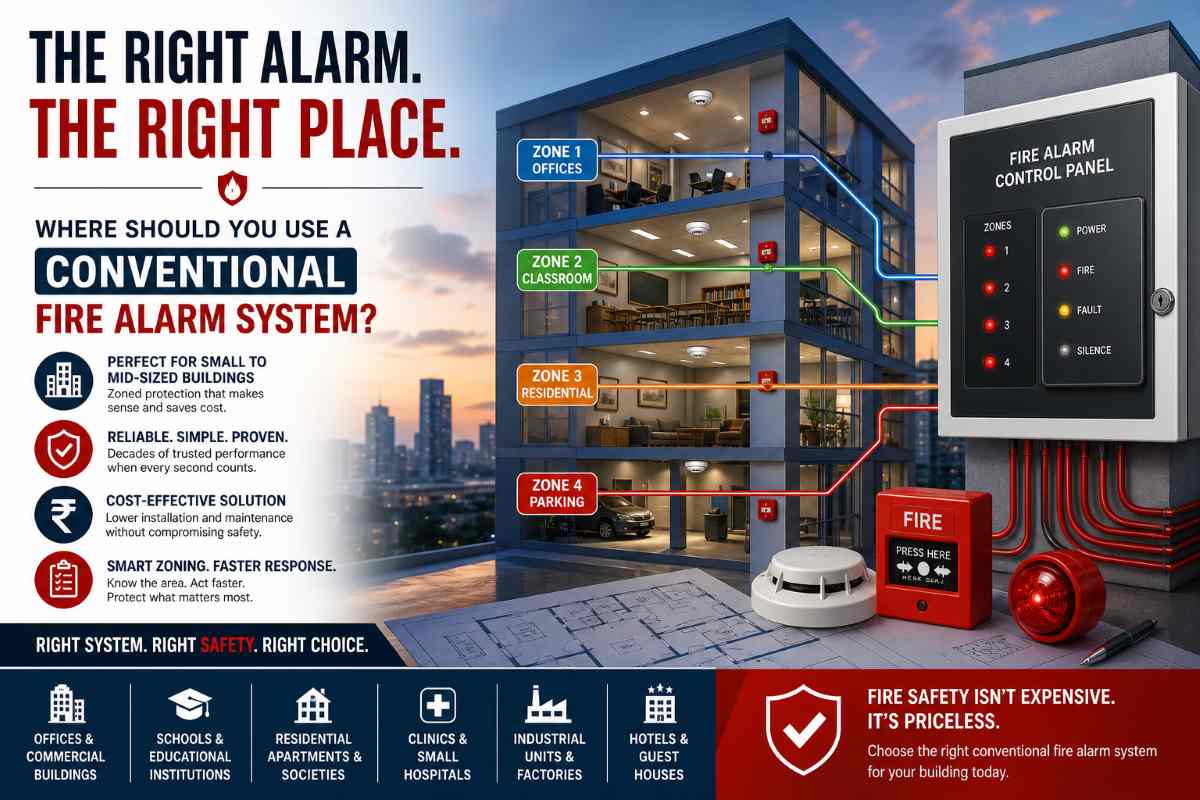
Fire safety is not a checkbox it’s a commitment. And choosing the right conventional fire alarm system for your building is one of the most critical decisions you’ll make. With multiple fire detection system options available in today’s market, many building owners and facility managers find themselves asking: Is a conventional system still the right choice for me?
The short answer? Absolutely — when used in the right setting. Let’s break it all down.
What Exactly Is a Conventional Fire Alarm System?
A conventional fire alarm system divides a building into multiple zones, with each zone connected to a central control panel via dedicated wiring. When a detector in a particular zone is triggered — whether by smoke, heat, or manual call points — the control panel lights up that zone, alerting responders to the general area of the emergency.
Unlike newer technologies, a conventional fire detection system doesn’t pinpoint the exact device that triggered the alarm. Instead, it narrows the response to a predefined zone — which works perfectly well in smaller or less complex properties.
These systems are the backbone of fire protection in thousands of buildings across India and the world, and for good reason: they are reliable, cost-effective, and straightforward to install and maintain.
The Buildings That Benefit Most From a Conventional Fire Alarm System
Not every building needs a sophisticated addressable fire detection system. Here’s where a conventional fire alarm system truly shines:
- Small to Mid-Sized Commercial Buildings
Offices, retail shops, and small warehouses with clearly defined zones are ideal candidates. When the building layout is simple and space divisions are logical, conventional zoning matches perfectly with the physical structure.
- Educational Institutions
Schools, coaching centres, and small colleges often have clearly separated wings or floors that map neatly onto conventional zones. The simplicity also makes it easier for non-technical staff to understand the alarm panel.
- Residential Apartments and Housing Societies
Mid-rise residential buildings benefit greatly from conventional systems. Each floor or block can be assigned a zone, giving residents and security personnel clear, actionable information during an emergency — without the complexity or cost of addressable systems.
- Healthcare Clinics and Small Hospitals
Smaller healthcare facilities with well-defined departments (OPD, wards, reception) can be zoned effectively. A conventional fire alarm system here ensures rapid evacuation zone-by-zone when every second counts.
- Industrial Units and Manufacturing Plants
Small-to-medium factories with defined sections — production floor, storage, offices — benefit from the robustness and simplicity of conventional systems. These environments can be harsh, and conventional systems are built to withstand it.
- Hospitality — Budget Hotels and Guesthouses
Properties with limited floors and simple layouts don’t need the complexity (or the price tag) of an addressable system. A well-designed conventional fire alarm system covers all the bases effectively.
Conventional Fire Alarm System vs Addressable System: Key Differences
This is the question every building owner asks eventually. Here’s a clear breakdown:
| Feature | Conventional Fire Alarm System | Addressable Fire Alarm System |
| Identification | Zone-level (area) | Device-level (exact detector) |
| Cost | Lower upfront cost | Higher upfront cost |
| Best For | Small to mid-size buildings | Large, complex buildings |
| Installation | Simpler wiring | More complex, loop-based |
| Maintenance | Straightforward | Requires technical expertise |
| Scalability | Limited | Highly scalable |
| False Alarm Management | Harder to isolate | Easy to isolate specific devices |
| Panel Complexity | Simple, easy to read | Feature-rich, detailed |
The verdict? If your building has fewer than 10 zones, is under 5 storeys, or has a relatively simple layout, a conventional fire alarm system is often the smarter and more economical choice. Addressable systems make more sense for large hospitals, malls, multi-storey towers, and complex industrial campuses.
The key isn’t which system is “better” — it’s which system is right for your building.
How Many Zones Do You Actually Need?
Zone planning is at the heart of designing a conventional fire detection system. A well-planned zone layout ensures that:
- Evacuation routes are clearly informed by the alarm
- Emergency responders know exactly which section of the building to prioritize
- False alarms in one zone don’t disrupt the entire facility
As a general rule, each floor of a building can be treated as one or two zones depending on size. Corridors, staircases, and high-risk areas like kitchens and server rooms should be individually zoned for faster response.
Why Conventional Systems Are Still the Industry Standard in Many Sectors
Despite the growing popularity of smart fire detection systems, conventional fire alarm systems remain the industry standard in a vast number of installations across India — and here’s why:
Cost efficiency — The total cost of ownership is significantly lower, both in installation and long-term maintenance.
Proven reliability — These systems have been tested and trusted for decades. They work — simply and consistently.
Easier compliance — For many building categories under Indian fire safety norms (NBC guidelines), a conventional fire alarm system meets all regulatory requirements without over-engineering the solution.
Faster response — Simpler systems mean fewer points of failure, and in an emergency, simplicity saves lives.
Meet Elixir Engineering — Mumbai’s Trusted Fire System Installers
When it comes to fire safety, you need more than just equipment you need expertise. Elixir Engineering is a Mumbai-based fire system installation company with deep hands-on experience in designing, installing, and maintaining conventional and addressable fire alarm systems across residential, commercial, and industrial projects. From initial site assessment and zone planning to final commissioning and annual maintenance contracts (AMC), Elixir Engineering delivers end-to-end fire protection solutions tailored to your building’s exact needs. Whether you’re a housing society, a factory, or a commercial complex, their team ensures your fire detection system meets all local compliance standards while keeping costs practical.
Frequently Asked Questions
Q1. Is a conventional fire alarm system suitable for a 10-floor building?
Yes, but it depends on the floor area and complexity. A 10-floor residential building with straightforward layouts can absolutely use a conventional system with one or two zones per floor. For mixed-use or very large floor plates, an addressable system may be more appropriate.
Q2. How long does a conventional fire alarm system last?
With proper maintenance, a well-installed conventional fire alarm system can reliably serve a building for 10 to 15 years. Annual servicing and detector cleaning are key to maximising lifespan.
Q3. Can a conventional fire detection system be upgraded later?
While conventional systems aren’t directly upgradeable to addressable ones (they use different wiring topologies), a professional installer can plan the initial installation in a way that minimises future upgrade costs.
Q4. What’s the biggest mistake people make when installing a conventional fire alarm system?
Poor zone planning. When zones are too large or don’t reflect the building’s actual layout, emergency response becomes inefficient. Always work with a certified installer to design your zone map before selecting equipment.
Q5. Do I need a fire alarm system even if my building is small?
Yes — and this is non-negotiable. Indian fire safety regulations require fire detection systems in most commercial and residential buildings above a certain occupancy or floor area. A conventional fire alarm system is often the most compliant and cost-effective solution for smaller buildings.
Q6. How is a conventional system different from a smoke detector you buy at a hardware store?
Standalone smoke detectors are single-point devices with no central monitoring. A conventional fire alarm system is an integrated network of detectors, manual call points, sounders, and a central panel — designed to protect an entire building, trigger evacuation, and potentially alert the fire brigade.
Don’t Overcomplicate Fire Safety
A conventional fire alarm system is not an outdated technology — it is the right technology for the right building. When properly designed and installed, it delivers the reliability, compliance, and peace of mind that every building owner deserves.
The real mistake isn’t choosing a conventional system. The real mistake is choosing the wrong system — or worse, no system at all.
Protect your people. Protect your property. Start with the right fire detection system, installed by the right team.